
|
|
||||
|---|---|---|---|---|
| Volume 56 Number 25, August 29, 2026 | ARCHIVE | HOME | JBCENTRE | SUBSCRIBE |
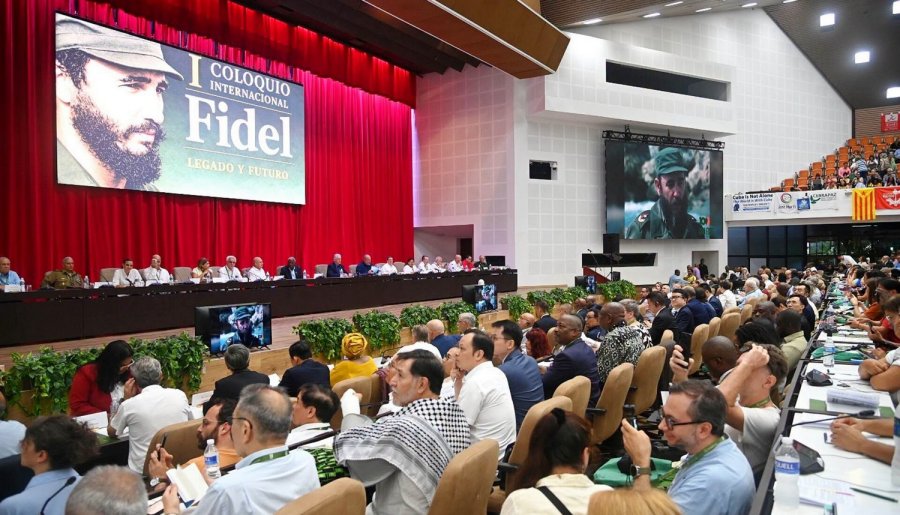
First International Colloquium: Fidel, Legacy and Future
held in Havana, Cuba, August 10-13, 2026
At Havana's Palace of Conventions, from August 10-13 Cuba hosted the First International Colloquium "Fidel: Legacy and Future," serving as the intellectual centrepiece of the centenary. Over 1,500 delegates from 63 nations gathered for panels and debate, reinforcing that Cuba is not alone and the Revolution remains a vital socialist inspiration. The events concluded at the Karl Marx Theatre with Raúl Castro, Miguel Díaz-Canel, and cultural performances, rounding off a vibrant nationwide celebration.
Miguel Mario Díaz-Canel Bermúdez, First Secretary of the Central Committee of the Communist Party of Cuba and President of the Republic, gave a keynote address at the opening on August 10, "Fidel's legacy challenges us today with more force than ever".
In his address to the distinguished academics, intellectuals, artists, social and political leaders, young students, and comrades who had come from the five continents to share this week of profound reflection on the man who marked the 20th century and whose thought illuminates the 21st, Miguel Díaz-Canel said: "Your presence in Cuba is an act of courage and consistency, because coming to Cuba today, amidst the intensification of the blockade and imperial hostility, is a gesture of militant solidarity that honours Fidel's legacy."
Miguel Díaz-Canel shared with the audience ideas that spring forth with no order other than that imposed by feelings, emotion, and the revolutionary commitment to the privilege of speaking about Fidel. He said, "Studying and embracing with conviction the immense work of the Commander-in-Chief, both in thought and action, is an imperative necessity for all of us who are committed to promoting economic and social transformations that will stop the process of suffocation to which the Cuban Revolution is being subjected, as part of a criminal war that has lasted for more than six decades.
"Saving the Cuban Revolution from one of the most serious threats it has faced in 67 years, under aggression of all kinds, is the greatest challenge of our generation, and we are honoured to take it on, convinced that we will prevail. This is not an unfounded certainty. We have a history steeped in heroism, a people trained in resistance, and the legacy of a leader who, always at the forefront of that people, transformed setbacks into victories.
"Preserving the gains that gave this heroic people the Revolution and socialism, breaking all the sieges that seek to annihilate the nation as collective punishment for its dignity, its resistance, and its decision not to surrender to the most powerful empire in history, is the first tribute we owe to Fidel, born 100 years ago in a country marked by injustice, inequality, and dependency-a painful reality that he vowed to change from his years as a rebellious and outspoken university student."
Miguel Díaz-Canel gave a profound appreciation of the Commander-in-Chief and his achievements. He emphasised that neither the Cuban Revolution nor Fidel Castro can ever be discussed without acknowledging this reality, this starting point, this state of affairs that demanded the most radical transformation of the 20th century in this part of the world.
He continued: "One need only review the country's current statistics, even under the terrible restrictions imposed by more than six decades of economic, financial, and commercial blockade and seven months of energy embargo, even amidst harsh blackouts, water shortages, high prices, and other problems that damage the very essence of society: the indicators for health, education, science, culture, and sports remain better than in other countries of similar development."
Miguel Díaz-Canel further explained Fidel's legacy of coherence and ethics, his legacy of intellectual audacity, his legacy of internationalism, and his legacy of revolutionary optimism.
Fidel taught us, Miguel Díaz-Canel said, that "Marxism-Leninism is not a dead doctrine; it is not a catechism, but a method, a guide, an instrument for concretely resolving life's problems."
Under Fidel Castro's leadership, he said, Cuba eradicated illiteracy in 1961 with a campaign that mobilized more than 250,000 volunteers. Just two years after his victory, he defeated an invasion at the Bay of Pigs (Playa Girón) financed, trained, and escorted by the neighbouring empire, inflicting its first major defeat in Latin America. Cuba built the most advanced universal healthcare system in the developing world. Cuba sent more than 600,000 healthcare professionals to 165 countries through the International Medical Co-operation Programme. Cuba developed a free education system from preschool through university. Fidel Castro designed the principles of Cuban foreign policy and built a robust cultural and sporting system, making it a benchmark for the world.
After discussing the international order, Miguel Díaz-Canel declared that the United States has no moral authority or right to single out Cuba, which has arguably been the nation most spied on by them and with the largest funds allocated to economic and ideological subversion. The intensified blockade of recent years, he said, is not just an economic measure; it is an undeclared act of war against a people who chose to be free. It is a systematic attempt to subdue, through hunger and despair, a nation that has demonstrated, for more than six decades, that dignity is non-negotiable.
"I am not exaggerating," he emphasised, "when I say that this colloquium is being held at one of the most difficult moments the Revolution has faced, but we are not here to indulge in nostalgia. We are here because Fidel Castro's thought remains the most accurate compass we have to navigate the storm the Cuban people are experiencing!" (Applause.)
"This capacity to resist and transform is rooted more firmly than ever in the thought and action of Commander-in-Chief Fidel Castro Ruz. It is about continuing the construction of socialism on a small island threatened by the greatest imperialism in the history of humanity and completely blockaded, whose state is cut off from all sources of resources, financing, and trade.
"Faced with this dilemma, it is necessary to produce and generate wealth to redistribute it with all possible social justice and to preserve the historical and essential achievements of the Revolution in strategic areas such as health, education, culture, science, energy, and communications.
Achieving this will be everyone's task-state-owned and non-state-owned enterprises, along with other forms of economic management that together comprise the Cuban business network-all focused on a single goal: building the prosperous and sustainable socialism that the heroic people of Cuba deserve."
Addressing the audience, Miguel Díaz-Canel said that Fidel is not the exclusive property of Cubans. Fidel belongs to all those who fight for a better world. And you, participants in this Colloquium, intellectuals and activists who have embraced its thought, have a decisive role to play.
He gave a call to spread the truth about Cuba and all peoples in resistance. He said, "In a world where the mainstream media fabricate lies and convenient narratives, you have the responsibility to be spokespeople for the reality that Cubans live: a reality of hardship, yes; but also of achievements, solidarity, and hope. Every book you write, every article you publish, every lecture you give in your countries is a bulwark against disinformation. The battle of ideas today is being fought in the digital arena against technological illiteracy and new forms of cultural colonisation.
"You must build effective solidarity networks; it is not enough to deliver speeches of support. Solidarity must be translated into concrete actions: campaigns for the lifting of the blockade, proposals for scientific and cultural co-operation, fair trade projects, and complaints before international organisations."
Fidel's Centenary is a starting point, Miguel Díaz-Canel said. It is the moment to recognise that his legacy is not in the past, but in the present and in the future we are building. It is not enough to remember him; we must study him! It is not enough to admire him; we must emulate him! (Applause.)
In concluding, Miguel Díaz-Canel thanked the audience as "the ambassadors of truth, the witnesses that Cuba does not surrender, the comrades on the journey of a revolution that transcends borders."
And he concluded by quoting Fidel: "We are prepared to resist the imperialist blockade with dignity and selflessness for as many years as necessary. If others compromise, if others allow themselves to be bribed, if others betray, Cuba will know how to remain an example of a revolution that does not surrender."
For the full speech, see:https://en.granma.cu/cuba/2026-08-11/fidels-legacy-challenges-us-today-with-more-force-than-ever