
|
|
||||
|---|---|---|---|---|
| Volume 56 Number 33, November 7, 2026 | ARCHIVE | HOME | JBCENTRE | SUBSCRIBE |
Workers' Weekly recently examined how the autumn Budget directs social product towards private interests and military production while preparing further restraints on social programmes. [1]
"Fiscal discipline underwrites every promise this government makes," declares the Budget. It presents falling government borrowing as the basis for economic stability and security. The Budget forecasts an average of £14 billion a year in additional government debt interest compared with the March forecast. It uses part of its fiscal buffer to accommodate this increase while requiring other commitments to fit its rules. The claims of creditors are treated as obligations; the requirements of society must accommodate them. [2]
The issue concerns the relations through which wealth is produced and appropriated. Workers produce the goods and services which sustain society. Their work puts materials, machinery, infrastructure and accumulated knowledge to use, transferring previously produced value into new products and creating new value. Production is a social process involving millions of people. Private ownership gives a small section of society the power to appropriate its results and decide their use. Instead, the producers of social wealth must become the authority which sets the economy's direction.
Household insecurity behind the fiscal promises
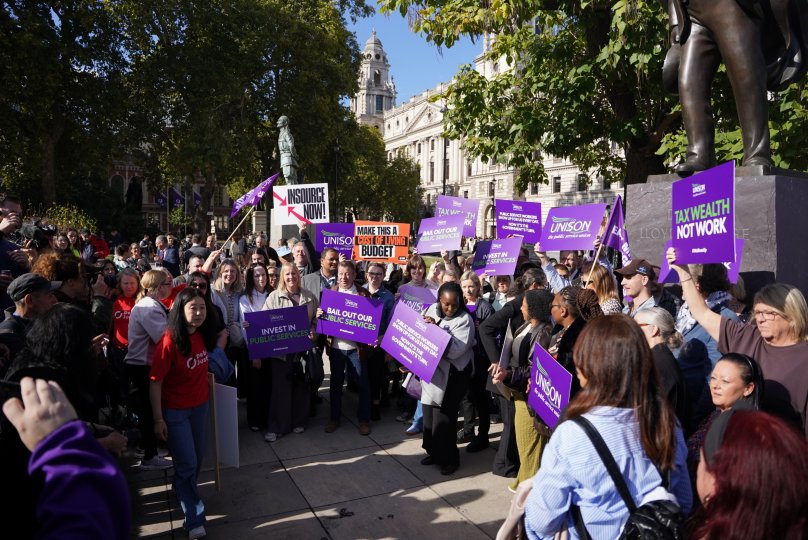
Cost of living pre-budget lobby on Parliament, October 13
2026
Richard Murphy's discussion of the Budget forecasts helps to expose the insecurity behind the government's promises. Government borrowing is projected to fall, he points out, while households save less, face higher mortgage costs and move collectively into net borrowing. His observations bring into focus the pressure on living standards concealed by claims of fiscal improvement. [3]
The Office for Budget Responsibility (OBR) projects household net lending changing from a surplus equivalent to around 1.75% of national output in 2026 to a deficit of around 1.25% in 2031. Household spending on consumption and investment, including housing, is expected to exceed income, with the gap covered through borrowing or the sale of financial assets. Meanwhile, corporations move towards a financial surplus and the rest of the world remains a net lender to Britain. [4]
The Budget celebrates its projected reduction in government borrowing from 4.2% of GDP in 2026-27 to 1.8% in 2031-32. Set alongside the household forecast, this exposes what its conception of improvement entails. The government's finances are to strengthen while households' financial position weakens. Consumption is expected to continue despite feeble growth in the income available to sustain it.
Murphy also highlights the poor outlook for living standards. The OBR projects that average household disposable income per person - after taxes and benefits, and adjusted for rising prices - will be only around 2% higher in 2030-31 than before the pandemic. Years of productive activity yield little improvement in the purchasing power available for people's lives.
The Budget's immediate answer includes a £100 Household Energy Payment from January 2027 for eligible households in England in council tax bands A-D, within a £2.6 billion package including funding for devolved governments. The electricity VAT cut is extended to July 2027. Such relief meets part of an immediate cost, while leaving households exposed to further price rises. The bank surcharge increase helping to fund it is itself limited to fifteen months. Temporary assistance leaves the longer-term pressure on household incomes intact.
Workers' wages represent a claim on the wealth society produces. Household borrowing maintains purchasing power today by committing future income to repayments and interest. Credit helps sustain the sale of commodities while extending lenders' claims over the wages with which workers must meet their needs. Working people continue to produce wealth, but an increasing part of their pay can already be committed to creditors before it is even received.
The household figures also combine people in opposing positions: workers paying rent and interest, and wealthy owners receiving income from property and financial assets. The same payment which reduces a worker's means of life provides revenue for an owner or creditor. The average conceals the relations through which ownership enables some to claim wealth produced by others.

For example, the OBR projects the average interest rate paid on outstanding mortgages rising from around 4% in 2026 to 5% in 2031, while mortgage debt relative to household income remains broadly stable. Higher interest charges would absorb more income even without an increase in that relative debt burden. More must be paid to lenders for access to the same housing.
The Budget commits £4.7 billion to the Your First Home equity-loan scheme, offering qualifying first-time buyers government loans of up to 20% of a home's value, with an initial five-year interest-free period. This eases the initial cost of buying, but the public assistance brings households into an arrangement in which access to a home depends on their ability to sustain a mortgage and meet the equity loan's eventual repayment terms. Public finance helps people enter the property market while leaving them dependent on creditors and exposed to future housing costs.
The Budget also allocates an additional £1.5 billion for around 10,000 social and affordable homes, prioritising Social Rent. Housing provision can therefore be organised through public funding and rents which do not require each household to finance a private purchase. The economic question concerns which relation is developed to meet the need for homes. Treating housing as a social responsibility requires public capacity to build, maintain and provide it according to need. Leaving households dependent on the property market makes their access conditional on sustaining the financial claims of lenders and owners. An allocation for social housing within that direction leaves this wider dependence in place.
What public investment is made to serve

Cost of living pre-budget lobby on Parliament, October 13
2026
The Budget provides an additional £15.4 billion of capital for the National Wealth Fund. It also commits the Fund and the British Business Bank to deploy up to £5 billion over four years into military production, technologies with both civilian and military uses, and other activities serving the government's national-security priorities. The latter commitment overlaps wider financing programmes.
Public loans, equity stakes and guarantees are used to attract private investment. Society supplies finance and assumes risks so that projects can satisfy the returns private investors require. Production may expand while private control over its direction and results is strengthened. The need for housing, energy or infrastructure must first become an opportunity acceptable to those owners.
The government promises in the Budget to back "a new wave of wealth creators". Its new Founders' Relief gives qualifying founders of high-growth, innovative companies a 10% capital-gains tax rate on up to £10 million of lifetime gains from April 2027. The owner realising a private gain receives a preferential claim on the proceeds. Those whose work produces the value receive no corresponding authority over its use. This identifies whom the government's conception of wealth creation is intended to encourage.
The priority given to militarisation of the economy further reveals the aim. The Budget supplies £3 billion towards the remaining cost of the Defence Investment Plan by further reducing departmental capital budgets, alongside £1.7 billion from the Treasury's capital Reserve. Buildings, equipment and infrastructure serving other purposes come under pressure to secure military spending. The government describes this as reprioritisation and warns that some departments may receive no inflation-adjusted increase at the next spending review. Military expansion is secured while other provision is required to adapt to the resources left available.
By contributing to GDP, arms production can be presented as growth while directing skills and resources towards preparations for destruction. An increase in output gives no assurance that society's capacity to provide for itself has improved. The aim of production and the use of its results determine the social content of that growth.
Securing the reproduction of society
The treatment of social programmes exposes the same inverted conception of wealth. Health care, education and other services produce and sustain the human capacities on which the entire economy depends. The value embodied in the capacity to work is reproduced through living labour. Enterprises employing workers benefit from the education, health care and social provision which develops that capacity.
Yet responsibility for financing its production, which is treated as a cost, is shifted onto public budgets and workers themselves. Institutions producing this social value must appeal for allocations and fit their requirements within fiscal limits. The Budget makes this discipline explicit in its stability rule: day-to-day expenditure must be covered by revenues by the third year of the forecast. The financing of services is made dependent on meeting that accounting condition, irrespective of the social value they produce and the needs they must fulfil. Private owners are presented as wealth creators requiring encouragement, while services developing society's human productive force are treated as costs to be restrained.
The result is a direction capable of sustaining financial claims while undermining the conditions of future production. Deteriorating health, inadequate education, insecure housing and worn-out infrastructure impair society's ability to reproduce and develop its capacities. Their repair requires labour, materials, training and investment. Delaying it to satisfy financial targets compounds the damage.
The pension proposals show how one social claim is made to finance another. From 2030, the government will adjust the State Pension Triple Lock, linking the change to its proposed National Care Service in England. It estimates pension expenditure will be £15 billion a year lower by the late 2030s than it would otherwise have been. This is a projected reduction against the existing pension arrangements, not an immediate cash cut. The promise of care is tied to restraining pensioners' future incomes, placing the requirements of older people in competition within the government's financial limits.
The government's fiscal "headroom" measures the gap between a forecast and a chosen financial rule. It measures neither these productive requirements nor society's potential to meet them. A new direction must secure the reproduction of society at the source of its wealth. Enterprises must meet direct obligations towards the social value they use. Public enterprise must provide productive capacity and public income. Investment and credit must be directed towards social requirements, and the wealth produced used to sustain and expand that provision. Technical advances could then reduce necessary labour and improve living conditions instead of enlarging private fortunes alongside insecurity.
The working class must set this direction. Its claims to wages, pensions and social programmes express the requirements of the people whose work sustains society. Their fulfilment must govern economic decisions. The security of society depends on developing its human and material capacities and ending their subordination to paying the rich and preparing for war.
Notes
1. "Autumn Budget 2026: The Working Class Must Set the Direction of the
Economy", Workers' Weekly, October 31, 2026.
https://www.rcpbml.org.uk/wwie-26/ww26-32/ww26-32-01.htm
2. Budget 2026, HM Treasury, October 28, 2026, especially the sections on
fiscal rules, household support, housing, investment, taxation and long-term
fiscal sustainability.
https://www.gov.uk/government/publications/budget-2026-document/budget-2026-html
3. Labour's budget doesn't add up, Richard Murphy, October 30, 2026.
https://www.taxresearch.org.uk/Blog/2026/10/30/labours-budget-doesnt-add-up/
4. Economic and fiscal outlook, Office for Budget Responsibility, October 2026,
paragraphs 2.30-2.32 and 2.58-2.59; Chart 2.16.
https://obr.uk/efo/economic-and-fiscal-outlook-october-2026/